

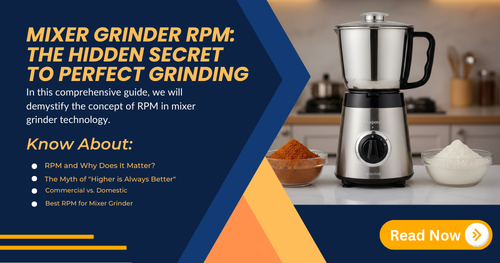
Mixer Grinder RPM: The Hidden Secret to Perfect Grinding
You have likely seen the term “RPM” plastered across mixer grinder boxes and online descriptions. It sits right next to the wattage, often boasting numbers like 18,000 or 22,000. But while most buyers fixate on the motor’s power (watts), very few pay attention to the speed at which that power is delivered. This is a critical oversight. Mixer grinder RPM is the unsung hero of your kitchen, determining whether your chutney is silky smooth or coarse, and whether your spices are powdered or just crushed.
For anyone serious about cooking, understanding the relationship between speed and texture is essential. A machine that spins too slowly will leave chunks in your batter. A machine that spins too fast might burn your delicate spices.
In this comprehensive guide, we will demystify the concept of RPM in mixer grinder technology. We will explore how motor speed impact grinding, what the best RPM for mixer grinder usage really is, and why faster isn’t always better. Whether you are a home cook looking for the perfect masala blend or a business owner evaluating commercial mixer grinder RPM, this article will help you make an informed choice.
What Is RPM and Why Does It Matter?
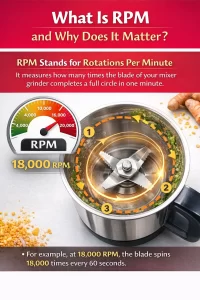
RPM stands for Rotations Per Minute. In simple terms, it measures how many times the blade of your mixer grinder completes a full circle in one minute.
If a mixer has a rating of 18,000 RPM, it means the blades spin 18,000 times every 60 seconds at top speed. This blistering speed is what allows the blunt edges of the stainless steel blades to pulverize hard ingredients like turmeric, lentils, and coffee beans.
The Role of RPM in Mixer Grinder Performance
Mixer grinder performance is a balancing act between torque (force) and speed (RPM).
- Torque is the muscle. It allows the blade to cut through heavy, thick loads like idli batter.
- RPM is the finesse. It determines how fine the final output will be.
High speed creates a vortex that pulls ingredients down towards the blades. It also ensures that the particles are hit repeatedly in a fraction of a second, breaking them down into microscopic bits. Without sufficient kitchen appliance RPM, you would end up with a gritty texture, no matter how long you run the machine.
Also, Read: Mini Mixer Grinder: Compact and Efficient Kitchen Companion
The Myth of “Higher is Always Better”
A common marketing tactic is to push high RPM mixer grinder models as superior. You might see ads claiming “23,000 RPM for instant grinding!” While speed is necessary, excessive speed can be detrimental.
The Heat Factor
Friction generates heat. When blades spin at 22,000 RPM or more, the friction between the steel and the ingredients creates a significant temperature spike.
- Flavor Loss: Essential oils in spices like cardamom, cloves, and cumin are volatile. High heat evaporates these oils, killing the aroma and flavor.
- Nutrient Loss: Heat-sensitive vitamins in fruits and vegetables can be degraded if the mixer grinder speed is too high for too long.
- Taste Change: Have you ever tasted chutney that seemed slightly bitter or metallic? That is often the result of “cooked” ingredients due to overheating during grinding.
Therefore, grinding efficiency mixer grinder capability isn’t just about raw speed; it’s about the right speed for the right ingredient.
Ideal RPM Ranges for Different Kitchen Tasks
One speed does not fit all. This is why good mixer grinders come with a speed control knob (usually 3 speeds + Pulse). Understanding which RPM range suits which task is the key to culinary perfection.
Low Speed (10,000 – 12,000 RPM)
This is typically “Speed 1” on your dial.
- Best For: Coarse grinding, chopping vegetables, and whipping.
- Why: You want control. If you are making salsa or chopping onions, you don’t want a puree; you want chunks. Low RPM provides that texture. It is also ideal for whipping cream or churning butter, where you need aeration, not pulverization.
Medium Speed (14,000 – 17,000 RPM)
This is “Speed 2”.
- Best For: Wet grinding, batters, and purees.
- Why: When making idli or dosa batter, you are dealing with a heavy, viscous mass. Medium speed provides a balance of torque and speed to keep the batter moving without overheating the motor. It ensures a smooth paste without burning the lentils.
High Speed (18,000 – 22,000 RPM)
This is “Speed 3”.
- Best For: Dry grinding spices, turmeric, coffee, and smooth smoothies.
- Why: To turn a hard stick of cinnamon into a fine powder, you need maximum impact velocity. The high RPM shatters the hard fibers instantly. Since dry grinding is usually done in short bursts, the heat buildup is managed.
Commercial vs. Domestic: The RPM Difference
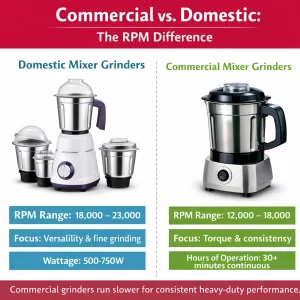
The requirements for a home kitchen differ vastly from a restaurant. This is reflected in the commercial mixer grinder RPM specifications.
Domestic Mixer Grinders
- RPM Range: 18,000 to 23,000 (no load).
- Focus: Versatility and fine grinding. Home cooks want super-fine chutneys and masalas quickly. The higher RPM compensates for the smaller motor (500W-750W) by using speed to cut through ingredients.
Commercial Mixer Grinders
- RPM Range: Often lower, around 12,000 to 18,000 (under load).
- Focus: Torque and consistency. A commercial kitchen grinds kilos of ginger-garlic paste at once. They don’t need blistering speed; they need the motor to keep turning without stalling under a heavy load. A lower RPM with a high-torque motor (1500W+) ensures the machine can run for 30 minutes straight without overheating or burning the food.
For a business, a high RPM mixer grinder isn’t always the goal; a high duty cycle machine is.
Also, Read: Your Ultimate Guide to Finding the Best Mixer Grinder in India
How Motor Speed Impact Grinding Efficiency
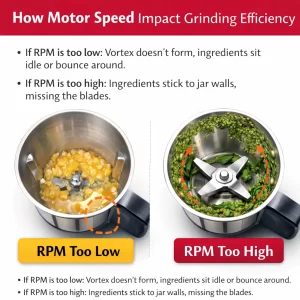
Grinding efficiency mixer grinder metrics depend on how well the speed interacts with the blade design and jar shape.
The Vortex Effect
At high mixer grinder RPM, the centrifugal force pushes ingredients up the sides of the jar. A well-designed jar has “flow breakers” (indentations on the wall) that disrupt this flow, pushing the ingredients back into the center where the blades are spinning.
- If RPM is too low: The vortex doesn’t form, and ingredients just sit at the bottom or bounce around.
- If RPM is too high: The ingredients stick to the walls due to extreme centrifugal force and don’t fall back onto the blades, leading to uneven grinding.
Particle Size Reduction
The physics of grinding is simple: impact. The blade hits the particle.
- Higher RPM = Harder Impact. This results in finer particles.
- Consistent RPM = Uniform Texture. If the motor speed fluctuates (due to poor quality), you get a mix of fine powder and coarse chunks.
The Best RPM for Mixer Grinder: What to Look For
When shopping for a new appliance, what number should you look for?
The Sweet Spot: 18,000 to 20,000 RPM
For the average Indian kitchen, a mixer grinder that delivers between 18,000 and 20,000 RPM is the gold standard.
- It is fast enough to make fine powders and smooth pastes.
- It is not so fast that it instantly burns your spices.
- It balances noise levels (higher RPM usually means more noise).
Variable Speed Control
The best RPM for mixer grinder usage is actually variable RPM. Avoid machines that have only one on/off switch. A rotary knob with at least three speeds and a “Pulse” function is non-negotiable. The “Pulse” function usually operates at top speed but gives you manual control to stop instantly, preventing over-processing.
Impact of Load on RPM
It is important to read the fine print. The RPM listed on the box is usually “No Load RPM”—meaning the speed at which the motor spins when the jar is empty.
However, once you add soaked rice or tough turmeric, the mixer grinder speed drops significantly due to resistance.
- Quality Motors: A good 750W motor might drop from 20,000 RPM to 16,000 RPM under load but will hold steady there.
- Cheap Motors: A weak motor might drop from 20,000 RPM to 8,000 RPM or stall completely.
This is where wattage meets RPM. You need high wattage to maintain high RPM under load. A 500W machine claiming 23,000 RPM will likely fail to deliver that speed when it actually matters.
Look: Bullet Master The Best Commercial Mixer Grinder Manufacturer in India.
Safety and Noise: The Downsides of Speed
High kitchen appliance RPM comes with side effects.
Noise Pollution
Sound is vibration. A motor spinning at 22,000 RPM creates significant vibration and air turbulence.
- Standard Mixer: 80-90 dB (equivalent to a lawnmower).
- High RPM / Heavy Duty: Can exceed 95 dB.
If you have a sensitive household, you might want to sacrifice a little speed for a “silent” model, which often runs at a slightly lower, more controlled RPM with better insulation.
Vibration and Stability
At high speeds, any imbalance in the jar (like unevenly distributed ingredients) causes violent shaking. This is why high RPM mixer grinder models must have:
- Strong vacuum feet to grip the counter.
- Locking lids to prevent accidents.
- Balanced blades to reduce wobble.
Conclusion
Mixer grinder RPM is more than just a number on a spec sheet; it is a defining characteristic of how your food will taste and feel. While the marketing hype pushes for higher numbers, the reality is that control and consistency are far more valuable than raw speed.
For most homes, a machine offering a maximum of 20,000 RPM with a 3-speed control provides the perfect versatility for everything from coarse salsa to fine turmeric powder. Remember, mixer grinder performance is a team effort involving the motor’s power (watts), the blade’s design, and the rotational speed.
By understanding how motor speed impact grinding, you can move beyond the “faster is better” myth and choose a machine that respects your ingredients. Whether you are blending a morning smoothie or grinding spices for a slow-cooked curry, the right RPM ensures that the texture is exactly how you intended it to be—perfect.
Also, Read: The Ultimate Guide to the Best Mixer Grinder Company in India (2026)
Why is RPM important in a mixer grinder?
RPM directly affects texture, consistency, and grinding efficiency. The right RPM ensures smooth chutneys, fine spice powders, and uniform batters without overheating ingredients.
Is a higher RPM always better for grinding?
No. While high RPM helps in fine grinding, excessive speed can generate heat, causing flavor loss, nutrient degradation, and even bitter taste—especially in spices.
What is the ideal RPM for a home mixer grinder?
For most Indian households, 18,000–20,000 RPM is ideal. It balances speed, texture control, noise, and heat generation for everyday cooking tasks.
What RPM is best for wet grinding like idli or dosa batter?
Medium speed (14,000–17,000 RPM) is best for wet grinding. It provides enough torque and speed to handle heavy batters smoothly without stressing the motor.
Which RPM range is suitable for dry grinding spices?
High speed (18,000–22,000 RPM) is ideal for dry grinding hard ingredients like turmeric, pepper, cinnamon, and coffee beans, especially when used in short bursts.
What RPM should be used for chopping or coarse grinding?
Low speed (10,000–12,000 RPM) works best for chopping vegetables, coarse grinding, whipping, or tasks where texture control is more important than fineness.
How does RPM differ between domestic and commercial mixer grinders?
Domestic mixers focus on higher RPM for fine grinding (18,000–23,000 RPM), while commercial mixers operate at lower RPM (12,000–18,000 RPM) but deliver much higher torque for continuous heavy-duty use.
Does the RPM mentioned on the box reflect real performance?
Usually, the listed RPM is no-load RPM (empty jar). Under actual grinding load, RPM drops. High-quality motors maintain stable RPM under load, while cheaper ones slow down significantly.
What should I look for besides RPM when buying a mixer grinder?
Look for variable speed control, good wattage to sustain RPM under load, well-designed blades, flow breakers in jars, safety locks, and stable anti-skid feet. RPM works best when paired with the right motor and design.